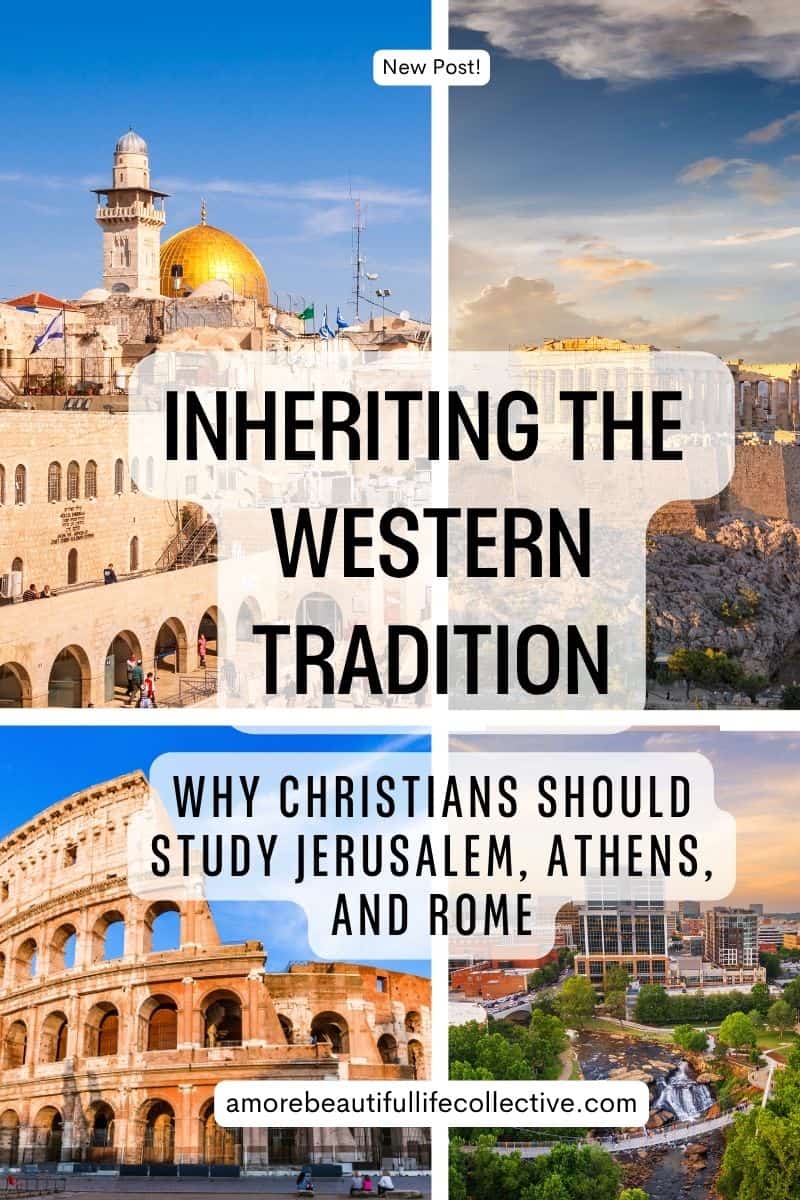
What do Jerusalem, Athens, and Rome have to do with the Christian faith we inherited? More than we might realize. The biblical faith of Jerusalem has shaped our Western tradition, the intellectual searching of Athens, and the order and duty of Rome. But Christians can fall into opposite ditches: rejecting this inheritance altogether or treating it as something beyond criticism. In this episode of The Faith We Inherit, we’re exploring what Christians can learn from these three ancient cities—and how we can receive the wisdom of the past without confusing it with the authority of Scripture.

S4E9 – Budgeting By Buckets: The Profit First Method for Personal Finance – A More Beautiful Life Collective Podcast
- S4E9 – Budgeting By Buckets: The Profit First Method for Personal Finance
- S4E8 – Budgeting 101: A Step-by-step Plan to Get Your Finances In Order
- S4E7 – Biblical Stewardship: What Should a Christian’s Money Goals Be?
- S4E6 – What Does the Bible Say About Money? | 20+ Scriptures on Finances & Biblical Stewardship
- S4E5 – What Do Jerusalem, Athens & Rome Have to Do With Your Faith?

Welcome to A More Beautiful Life Collective Podcast. I’m Cayce Fletcher, and I’m here to walk hand in hand with you as we grow in grace, build with purpose, and live beautifully.
This season on the podcast, we are considering the faith we’ve inherited. How do we approach the Bible, truth, and tradition faithfully?
We’ve considered how we all are inheriting something—and that we should examine the faith we’ve received. As we examine our faith, questions will inevitably arise, but these questions should push us toward a deeper love of God rather than leading us away from him.
Where do we turn to sort out our questions? We have to turn to the Bible alone. As the very word of God, we hold it to the highest authority. Tradition and other written wisdom collected by the church are valuable for our encouragement, but it is not held to the same authority as Scripture.
We haven’t only inherited doctrines. We’ve inherited ways of thinking, learning, worshiping, organizing our lives, asking questions, and understanding what it means to be human.
All aspects of what we have discussed build to a framework that we can use to approach our lives and live them faithfully. In each post, I’ve noticed that I continue to draw upon the Golden Mean to help us navigate the ditches we may fall into—there are extremes related to the Bible, tradition, and examining our faith that we must avoid if we want to press on towards Jesus and finish our faith well.
The Golden Mean is a philosophical term that is most often attributed to Aristotle (as well as Plato). Interestingly, this idea pops up across other cultures and philosophical and religious traditions.
Sometimes, as you read the Greeks and Romans, you catch yourself wondering: How did these people develop such a sophisticated understanding of ethics without the truth of the Gospel?
How did they formulate something that echoes the same truths that we find in biblical wisdom literature—like in the Proverbs?
Today, we are going to consider the question of how to approach the Western Tradition. Let’s dive in.
The Three Great Cities
I first got to thinking about this idea after reading an article in The Classical Teacher by Martin Cothran called “The Three Cultures.” (It is definitely worth reading in its entirety!)
In it, he describes how Western Tradition is made up of the cultures of the three great cities: Jerusalem, Athens, and Rome.
- From Athens, we receive the values of strength and intelligence.
- From Rome, we receive the values of order and piety.
- From Jerusalem, we receive the values of faith and obedience.
Western Culture then melds these values together to create the Classical Christian Western Tradition and all of the riches that it holds.
Christians in the West have inherited a civilization shaped by all three, and we impoverish ourselves when we either blindly worship that inheritance or arrogantly assume we have nothing to learn from it.
The Myth of No Culture
In today’s modern world, we have bought into the lie that we have come from nowhere and that we are going nowhere. What seems like great freedom really only results in the vapid shallowness of a “Brave New World” like focus on consumption and distraction.
In an attempt to be inclusive, we throw out everything that truly makes us who we are. We do this to our detriment.
This is not just something that our post-1960s ‘woke’ colleges have done through critical race theory, etc. It is also something that Christians have done to themselves in their suspicion of great books, thoughts, and people.
In one White Horse Inn episode, someone called in and asked if it was ‘against the Bible’s to go to college and receive a higher education. The hosts wisely shot down this question—but it shows how anti-intellectualism has permeated mainstream Christianity.
We are distrustful of institutions and traditions and prefer to throw the baby out with the bathwater.
In effect, our response to the great tradition we’ve inherited is the same as those on the far-left. We reject it and prefer to go on our own path—even though it has never been proven that our path leads to a virtuous life.
Faithful Christians are neither rootless nor blindly traditional. We are heirs who have been given something to steward.
To get back to the heart of the matter, we must walk in the ancient paths of these cities. And we do this through retrieving the knowledge these cities left behind. We must study what they studied and learn to love what they loved to teach our heart to desire what is good, true, and beautiful.
Related: You Need a Personal Statement of Faith (and how to make one)
Jerusalem: Why Study the Old Testament?
The first city we come to is one that we probably will not question the study of. A proper understanding of the Bible recognizes that it is saturated in the ancient Jewish culture. We only understand what the New Covenant is if we look back at the covenants that came before.
If we want to understand who Jesus is, we have to read him in the context of who the Jewish Messiah is. That requires study of the Old Testament.
For Bible-believing Christians, this should be a no-brainer. Obviously, we have to study the Bible in order to know the Bible. And that means that we have to study the Bible in its entirety—not just pick the parts that we like best.
But slogging through Leviticus is often the death of every well-meaning resolution to read through the Bible in a year. Remember, we study the Old Testament to learn more about God and his plan for humanity—which hinges on covenants.
As we read through the Old Testament, we understand why holiness is tied to obedience, and we also understand how God is merciful and desires a heart-posture of faith above all.
The Bible—including the Old Testament—is the foundation of our worldview, and we must have a solid understanding of who God is in the context in which he has revealed himself before moving to the two other great cities.

Athens: Why study Greek myths?
My son is enrolled in a Highlands Latin Cottage School, which uses Memoria Press’ curriculum. This is a rigorous classical education, starting Latin in the 3rd grade with the expectation that they will be translating Caesar and Cicero in high school.
The spine of their curriculum is Latin and the study of the classical cultures of Greece and Rome. Inevitably, someone will pop up on the Memoria Press Facebook group (or maybe in-person at the beginning-of-the-year parent meet-and-greet) and ask, “This curriculum is supposed to be Christian! Why are we reading these Greek myths?”
Cheryl Lowe, in her article, “Should Christians Read Pagan Classics?”, sums it up: “We are all Greeks when we come to God: searching, asking, debating, questioning, doubting, wondering. The Greeks are our guides because they asked all of the right questions, and asking the right questions is half the battle. And they explored answers with a depth and insight that is astounding. It was Cicero, building on this Greek inheritance, who led St. Augustine to Christ. It was Vergil, using Homer as his model, who led Dante up to the gates of Heaven. The pagan classics can do the same for us.”
One response on the Memoria Press forum put it this way, “To study the Greek myths is to better understand ourselves. We see where they missed the mark answering eternal questions, and we see how the timing was right for Jesus to arrive and lead to the correct path.”
Another person went even deeper with their analysis here: “One thing that I consider important to keep in mind as you teach mythology is that while they need to know the references for future reading of the classics, the Greek gods give insight into the human condition. They were personifications of virtue and vice that the Greeks observed. For example, when speaking about Ares, the D’Aulaires book says, “Ares, god of war, was tall and handsome but vain, and as cruel as his brother Hephaestus was kind.” The student should be led to see that war can be attractive (tall and handsome) for what a people can gain (land, resources, and hopefully peace from enemies in the future), but that it is motivated by vanity (a country always thinks it is better than the other) and leads to tremendous cruelty. And the contrast to Hephaestus, the god of the forge, is telling as well: men who spend their days occupied in honest work can more easily see the needs of others and empathize with them but those like Ares who stand idle react like him: “When Ares heard the clashing of arms, he grinned with glee, put on his gleaming helmet, and leapt into his war chariot.”
Visit A More Beautiful Life Collective Shop for bible studies, planners, and other resources.
It can easily be overlooked that the Greeks were the first to develop the idea of human virtue (habits to do the good) and what that meant. They listed four primary virtues: prudence, justice, fortitude, and temperance. Early Christian apologists would take those virtues and promote them as important for all people, whether Christian or not. However, only with the revelation of Christ did we receive the idea of the theological virtues of faith, hope, and love. All this relates to mythology when you realize that the myths were the instruments by which the Greek people learned their morality. That they had a god of war does not mean that they worshiped war, but that they were aware of how serious a decision that was and that the outcome of a war was out of their hands and they may be the loser–so they must tread carefully when considering it. That they had a goddess of beauty does not mean that they were full only of immorality and licentiousness (obviously as sinners there was some of that too) but that there was an awareness of the goodness of creation (cf. Genesis 1) and it can be a calling to lift our minds to more heavenly things (cf. Col 3:1-2). So some important lessons should be learned from the mythology if understood in the proper way.
I think your daughter is somewhat correct in characterizing the mythology as “dark”–after all, the light of Christ had not been revealed yet. Christianity’s saving message completely changes our outlook, while the Greeks were left alone only with their human talents–which we all know will not go far without grace. Contrasted in this light, it becomes easier to see the line between the human and the divine, and the need for grace becomes clearer.”
This beautiful response shows both the need for the Gospel and the way that the Greeks’ searching helps us to know ourselves better. Paul spoke to the Greeks and told them that they were not far off from the truth of who God is. They were the people that God first sent the Gospel to after the Jews. Their examining spirit, exemplified by the Bereans, paved the way for the rest of Christendom. We can gain much wisdom from studying them as well.
Rome: Why Study Latin?
That brings us to another cornerstone of a classical education: the study of Latin. Often thought of as a dead language only helpful for the SAT, Latin is actually the spine of a classical education.
Why? Simply because Latin does for us the same thing that Math does, just in language form.
In Cheryl Lowe’s article, “Why Study Latin?”, she describes one of the benefits: “The mental discipline Latin instills in students makes it the ideal foreign language to study. Latin originated with the Romans, and their character pervades the language they created. The Roman, says R. W. Livingstone, “disciplined his thought as he disciplined himself; his words are drilled as rigidly as were his legions, and march with the same regularity and precision.”
Latin is systematic, rigorous, analytic. Its sentences march “serried, steady, stately, massive, the heavy beat of its long syllables and predominant consonants reflecting the robust, determined, efficient temper” of the Romans themselves.”
The Romans were able to rule for 1,000 years because of their order and precision. It was in this stately empire that God chose to send his Son. And, because of the structures and institutions of this empire, the word of the Gospel was able to spread—despite persecution—to the far reaches of the Western world.
Yes, the Roman world was hostile to Christians for the first few hundred years. But the remainder of the Roman Empire saw Christendom rise to its greatest heights—literally in the case of the Gothic cathedrals of the Middle Ages.
It was in this time that Christianity was systematized, that liturgies were created, and that the world turned and moved around the church and its beliefs.
If we learn the importance of dependence on and obedience to God from Jerusalem and the importance of investigating questions to develop wisdom and moral character from Athens, then Rome teaches us the importance of duty to God and man to develop a society that runs in an orderly way.
God is a God of order—not chaos. The universe is not just spiraling into a discombobulated mess. No, God created a cosmos with wisdom and intention. We see the effects of sin in the atrophy we witness—in our bodies, our homes, and our communities. But when God first set up the world, he brought order out of chaos. We are called to do the same.
What did God give man to equip him to do his purposes on Earth? Yes, Adam was given his strength and mind. But as time went on and people groups grew, God chose to operate in institutions. Institutions, when they are based on God and his law, give mankind a way to put aside a preoccupation with self, submit to a higher authority, and achieve something greater than themselves.
The Romans were misguided in their use of institutions (and there was much suffering caused by that misuse). But we can recognize how the institutions they founded led to longevity and stability.
The Middle Way: Forging a path between Athens, Rome, and Jerusalem
These are the ancient paths—the study of faith and obedience, strength and wisdom, order and piety. Studying what best represents these cities—the Bible, Greek Myths, and Latin—is one way to catch a glimpse of how these people think. To learn more about them and how we can follow in their footsteps.
But there is always a danger. The Golden Mean speaks of the middle way between all the ditches on each side. There are perilous cliffs we may fall from if we stray from the middle way.
If we live too fully in one city, forsaking the rest, we will have a skewed understanding of God, humanity, and our purpose in life.
We will reject anything that smacks of the other cities—not understanding that these cities are part of our heritage too. Anything remotely institutional is viewed with distrust (and maybe even called evil). Anything that deals with the intellect seems snobbish or just meaningless—faith alone means that philosophy is dead. Or, anything that requires obedience is suffocating and should be rejected for the sake of freedom.
We seek the virtuous path. And that means we seek the path that pulls the virtues from these cities while avoiding the pitfalls.
Related: How to Develop a List of Christian Virtues for a Strong Christian Life
In my own community, I have seen the dangers of this imbalance. Biblical Unitarians seem to lean towards Jerusalem, while rejecting Rome and Greece. The implications of this are often seen in their distrust of authority—some even proudly counting the number of years since they’ve been to church—as well as their tendency to drift into legalism and Torah observance.
On the other hand, I’ve also known people who fall into the trap of one city. Those who lean towards Athens drift into a fuzzy agnosticism. Like the original Greek city with their plaque “To an Unknown God,” these people approach God, “whoever he or she may be”, with indifference. They are not willing to submit to any rules. They are not even willing to submit to any definite answer. They “are just on a journey” and encourage you to do as you wish as long as you don’t bother them. They are distracted by philosophies and rabbit trails (and maybe who the Nephilim are in Genesis 6), but they never actually want to come close to the Living God.
Those that fall towards Rome often hold up the institution at all costs. The institution is god. This is done obviously in the Orthodox and Catholic view—when tradition is king. But I believe that many modern institutions are exalted and placed on the same level as God. The state is worshiped and looked to fix all our problems (both by the left and right). Educational institutions are given the role of shepherding the young, teaching them what our society values. And let’s not forget that Sports and entertainment were an important part of the Roman world. In our modern society, it is an institution unto itself.

Which Ditch Are You Falling Into?
Throughout this season, we have been asking what it means to faithfully receive the faith we have inherited.
That requires us to do two things that can sometimes feel like they are at odds with one another: receive with humility and examine with wisdom.
We should not blindly accept something simply because our parents, our church, our denomination, or our civilization handed it to us. But neither should we assume that we are wiser than everyone who came before us simply because we happen to be living now.
We are heirs.
And good heirs learn the value of their inheritance before they start selling off the family estate.
That means we should examine not only the doctrines we have inherited, but the instincts we have inherited about authority, knowledge, obedience, institutions, freedom, virtue, and even what it means to live a good life.
So where are you tempted to fall into the ditch?
- When you encounter something you have inherited, is your first instinct to receive it uncritically—or reject it reflexively?
- Are you suspicious of authority simply because it is authority? Or are you willing to excuse wrongdoing because you believe preserving an institution is more important than confronting its failures?
- Do questions drive you toward truth—or have you made questioning itself the goal?
- Are you willing to arrive at an answer and submit yourself to it, even when you don’t particularly like the answer?
- Do you confuse faithfulness with refusing to think deeply? Or have you become so enamored with intellectual exploration that simple faith and obedience seem beneath you?
- Do you recognize the value of institutions—the family, the church, the school, the community—without expecting those institutions to save us?
- Do you value freedom so highly that obedience feels oppressive? Or order so highly that freedom feels dangerous?
- When you discover failures in the Christian tradition, do you believe those failures require us to abandon the tradition altogether?
- When you discover wisdom outside the Christian tradition, do you immediately distrust it because it came from a pagan—or accept it without measuring it against the revelation God has given us?
And perhaps most importantly:
What are you passing down?
Because the Faith We Inherit cannot only be about looking backward.
Related: Why You Should Study Church History (And Not Idolize It)
We are standing in the middle of the chain.
We received something from the people who came before us, and—whether intentionally or unintentionally—we are handing something to the people who come after us.
Our children will inherit our beliefs. But they will also inherit our posture toward the Bible. Our attitude toward the church. Our willingness to ask difficult questions. Our respect—or contempt—for authority. Our intellectual curiosity. Our habits of obedience. Our understanding of duty. Our loves.
They will inherit the things we teach them explicitly, but they will also inherit the things they watch us love.
So the question isn’t simply whether we will preserve the inheritance exactly as we received it.
The question is whether we will receive it humbly, examine it faithfully, correct it where it has gone astray, preserve what is good, and pass it on more faithfully to the next generation.
The City We Are Actually Looking For
Ultimately, none of these cities is our home.
Not Jerusalem. Not Athens. Not Rome.
We learn from them because they are part of the inheritance that formed us. We retrieve what is good from them because we are not arrogant enough to believe that wisdom began with us. But Christians are not trying to resurrect ancient Greece, rebuild the Roman Empire, or retreat into first-century Judaism.
We are looking for another city.
The middle way leads us toward the City of God.
There, the questions Athens asked find their answer in the God who is Truth. The order Rome sought finds its proper King. And the faith and obedience of Jerusalem reach toward the fulfillment of everything God has promised.
That is why we can receive our inheritance without worshiping it.
We can read the pagans without becoming pagan. We can value institutions without making them gods. We can honor tradition without placing it above Scripture. We can ask hard questions without making doubt a virtue. And we can submit ourselves to truth without becoming afraid of inquiry.
We do not have to choose between becoming people with no inheritance and becoming people enslaved to our inheritance.
We can become faithful heirs.
We can receive what has been handed down, hold it up to the light of God’s Word, keep what is good, reject what is false, and pass on something worth inheriting.
What do you think? I would love to hear how you would approach these three cities and the knowledge and virtues that have in the comments.
If you’ve enjoyed this episode, subscribe and leave a rating and review wherever you listen to podcasts. You can also send it to a friend or family member to keep the conversation going.
You can walk through retrieving the faith you’ve inherited with the free Family Faith Inventory. If you would like to go deeper, you can get the Faith We Inherit Workbook on the AMBL shop. This will walk you through the process of documenting your faith, listing where you want to learn more, and creating a rule of life to help you pass that faith onto your children.
This episode wraps up part 1 of our Faith We Inherit series, which covered why we need to examine our faith. Part 2 of this series will cover “How do I know what’s true?”, which we’ll start in a few weeks. Next time, we’re going to be taking a break from this series and turning to a practical mini-series on budgeting and stewardship.
Until then, keep creating a life you love and cultivating your heart for God.


The Faith We Inherit | Family Faith Inventory & Formation Workbook
What faith are you handing down?
The Faith We Inherit is a 66-page Family Faith Inventory & Formation Workbook designed to help parents examine the beliefs, traditions, practices, and values they’ve inherited—and thoughtfully consider what they want to pass on to the next generation.
Through guided reflection, Scripture study, theological questions, and practical family formation exercises, you’ll move from what you inherited to what you believe to how you want to live.
Includes the Keep Growing: 12-Month Family Theology Plan as a bonus download.
***If you have enjoyed visiting A More Beautiful Life Collective, please like, comment, share, and subscribe. Let’s make the world more beautiful together. This post contains affiliate links. If you purchase something through this link, I earn a small commission at no cost to you. It’s a win-win!***

Leave a Reply