We all have inherited a faith and tradition that forms our souls to love what it loves. We must approach this faith with wisdom, discernment, and a desire for what is good, true, and beautiful. Faith tradition is not something that should shackle us. It is something that propels us to the depths and riches of God. This episode kicks off Season 4, which will be an exploration of The Faith We Inherit.

S4E7 – Biblical Stewardship: What Should a Christian’s Money Goals Be? – A More Beautiful Life Collective Podcast
- S4E7 – Biblical Stewardship: What Should a Christian’s Money Goals Be?
- S4E6 – What Does the Bible Say About Money? | 20+ Scriptures on Finances & Biblical Stewardship
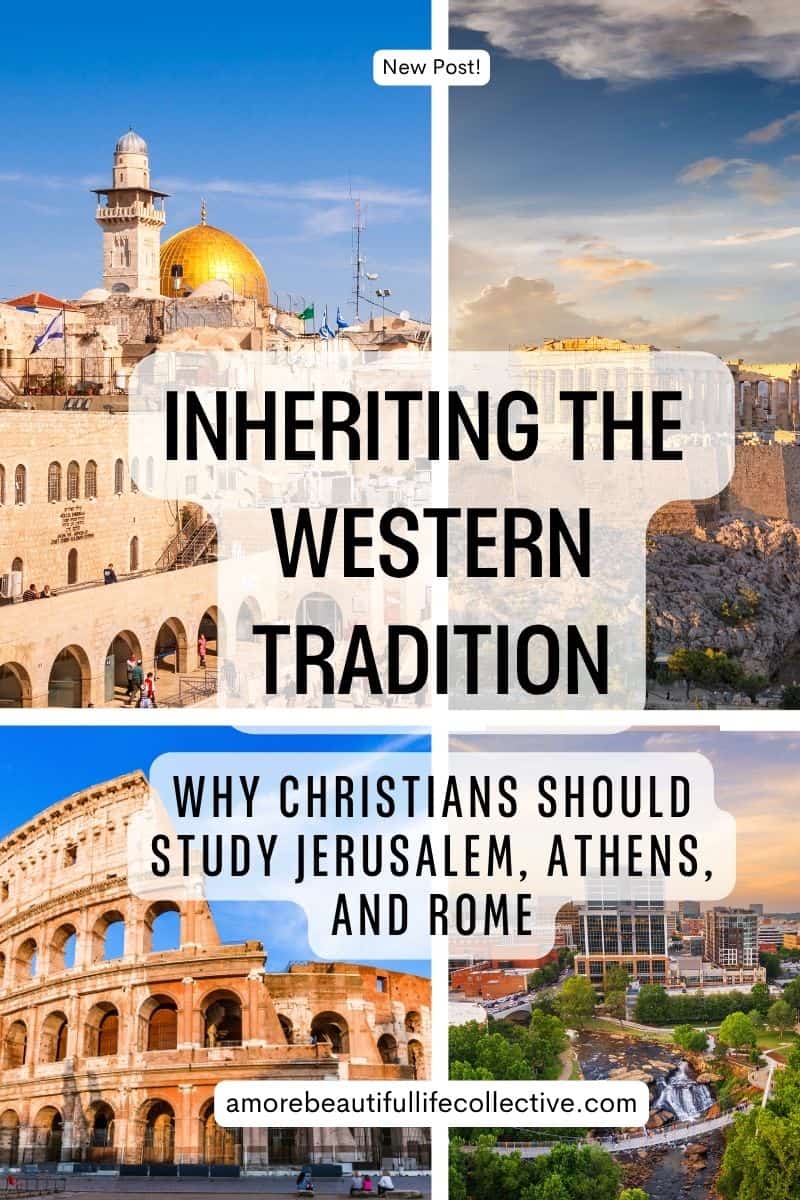
- S4E5 – What Do Jerusalem, Athens & Rome Have to Do With Your Faith?
- S4E4 – You Don't Have to Agree With Them to Learn From Them: Why You Should Study Church History
- S4E3 – Bible Alone? Can We Really Just Follow the Bible?

Hi everyone, and welcome to Season 4 of A More Beautiful Life Collective Podcast! I’m your host Cayce Fletcher, and I’m here to walk hand in hand with you as we grow in grace, build with purpose, and live beautifully.
Classical Education and a Call to Tradition
Summer is winding down here, and I’m currently making the final preparations for homeschooling my son, who is starting first grade. He attends a one-day-a-week cottage school as well, and I’ll be stepping back into the classroom this year to teach 3rd grade Intro to Composition and Literature A.
In preparation for this role, I’ve been steeped in what it means to classically educate our young ones. Education is not just for the increase in knowledge. Education is meant to mold the soul to love the true, good, and beautiful.
The phonics practice and mathematical skills that my son is learning now are done in order to prepare him to read Dante and do calculus when he reaches the final years of schooling. They learn Latin now in order to read Cicero later. The hard work shapes their character, and the content shapes their heart.
The curriculum we use – Memoria Press – is unapologetic in its goal of preserving and passing on the best of Western Civilization. Time is a kind of sieve. It allows us to see what has endured, what has produced good fruit, and what is worth carrying forward.
All tradition is like this.
Why Traditions (and Faith Tradition) Matter
As we go through the years, events and activities come and go, but certain things remain. Those things stand the test of time. They mean something. They are worth passing on. They matter—because they help us to know our identity.
As a young family, we are still shaping our traditions and trying to figure out what to keep and what to get rid of. Reading Twas the Night Before Christmas in brand new Christmas pajamas on Christmas Eve — a keeper. A movie night with pizza each Friday — yes, please. Others come and go. We’ve tried to do cousin phone calls and a few big family trips to the beach, and those haven’t quite amounted to tradition.
Not everything we do is worth preserving or passing on.
Related: How Traditions Cultivate Your Faith and Disciple Your Family
Visit A More Beautiful Life Collective Shop for bible studies, planners, and other resources.
Does Tradition Matter in Churches?: How a Faith Tradition can stabilize and strengthen communities
I just got back this week from a trip down to Atlanta for the Church of God General Conference. This is a meeting between the member churches of the denomination. As a teenager, I didn’t quite get the purpose of what these meetings meant. It just seemed like a collection of business meetings with odd rules, with a couple of sermons thrown in.
But I’m beginning to recognize more and more the importance of the traditions that are passed on.
While we were there, one of the members was recognized for attending for 81 years (!) without ever missing an annual conference. He has remained faithful, as his parents and grandparents were before them. His children and grandchildren are also faithfully there, too.
At the same time, one of the ‘matters of business’ was a change to the conference statement of faith. Some of the wording needed to be clarified and changed in order to make sense and be brought more in line with what we actually believed—in accordance with what the pastors and leaders of the conference were thinking.
Like the Bereans, we sat there and talked through what these changes meant and the reasoning behind keeping the language and leaving it behind. There was healthy dialogue that amounted to an answer that most people agreed with, as evidenced by the vote cast by the delegates.
I’m sure my teenage self wouldn’t have quite understood what she was witnessing with the motions and ‘so moved’ and the delegate cards. But now that I’m older, I more clearly see: We are just trying to sift through the tradition we inherit in real time, holding onto the best parts and letting go of what is not proved out by scripture.
As the Executive Director said in his opening, our faith tradition stabilizes us, strengthens us, and leads to longevity for us.
Inheriting Faith Tradition
We all inherit a faith tradition. In this hyper-individualistic age, we like to think that we are completely autonomous with no interference from the past, but we are not. More and more, people are recognizing that entering into tradition grounds you. It provides deep roots. It provides a rich inheritance.
When we embrace the river of tradition that we wade into, we can better understand where we have come from and where we are going. We do not need to reinvent the wheel. We do not need to break away completely from our past. We do not need to imagine that we are the only ones who have ever thought the way we think or have done the things we’ve done.
We inherit faith tradition.
But that does not mean that all things we inherit are worth saving.
What is worth saving?
There are a few accounts of Facebook that are just about people sifting through the collections they have inherited from their parents or grandparents. It could be baseball cards, collector’s items, or rare dolls. The parents or grandparents spent their lifetime gathering more and more things only for the majority to be sold for pennies on the dollar at estate sales or just given away to Goodwill.
Not everything we inherit is a treasure. Not everything results in generational wealth (and some of what we inherit may actually be more like a generational curse).
Each year, there are 4.2 million new books published. The average reader will only read about 700-800 books in their lifetime. We all know that not every book published is worth passing down to the next generation. To pass on the best things to the generation coming next, we must sieve through thoughts, knowledge, and ideas. That means we have to be pursuing those good things ourselves.
1 Corinthians 3:12-15 (NIV) says, “12 If anyone builds on this foundation using gold, silver, costly stones, wood, hay or straw, 13 their work will be shown for what it is, because the Day will bring it to light. It will be revealed with fire, and the fire will test the quality of each person’s work. 14 If what has been built survives, the builder will receive a reward. 15 If it is burned up, the builder will suffer loss but will yet be saved—even though only as one escaping through the flames.”
We are all building a legacy that will be refined in the future. Those who build with gold and silver will be made even more beautiful and refined in the fire of judgment. Wood, hay, and straw will be burnt up, with no real memory left.
What are we leaving behind?

The Faith We Inherit
This season on the podcast, we are focusing on The Faith We Inherit. The question I want to ask is: What happens when we take Scripture seriously, listen to the Christians who came before us, ask hard theological questions, and still have to get up tomorrow morning and raise our children?
We do not exist in a vacuum. We do not go in our closets and close the door with ‘just us and our Bibles.’ We look back to all the people who came before us, and we look forward to the generations coming after us.
We need to handle our present reality rightly. We want our legacy—our work—to withstand the refiner’s fire.
What does it mean to inherit Christianity rather than invent it?
Ecclesiastes tells us there is nothing new under the Sun, but I grow tired of hearing the speakers and thought leaders continually tell us how they found something new that has never been heard before.
We shouldn’t approach Christianity as though we are the first people to ever ask these questions. We reach new understandings ourselves, but they are not new when it comes to the great tradition of history.
At the same time, traditions can also become shackles. It’s cliché to talk about the small town with oppressive traditions that force people to be in roles that they’ve never asked for, but the oppressiveness of traditions goes back to millennia—to the dusty paths that Jesus walked on as he debated the Pharisees over how they handled tradition.
Tradition placed above God never results in righteousness. It results in idolatry.
If the tradition we inherit from our past is held above God, Jesus, and the hope of the Kingdom, then it is idolatry too.
The Golden Mean, like in so much of life, is at work here too—not as a compromise between truth and error, but as a search for the virtuous way between two distortions. We cannot buck all tradition and try to invent everything ourselves (so often that results in just recreating what someone has done before without the wisdom they learned in already implementing it). We also cannot hold tradition so highly that it comes before God and relationships.
So what does it mean to inherit Christianity rather than invent it?
Related: You need your own Personal Statement of Faith
3 Questions to Ask About Our Faith
We must practice the sifting of our faith.
As we do, we will answer three questions:
- What did you inherit?
- What do you want to keep?
- What are you questioning?
As I’ve talked about in a previous podcast, we have to create our personal statement of faith. We do this not because we just want to be unique. We do this because we want to take ownership of our faith and do the hard work of understanding what we believe.
I’ve been searching out what I believe for a few years now. From the nature of God and Jesus to the doctrines of salvation and even eschatology, I am better because of the depth of study. I can better understand the other side, I can better teach my kids, and I can better apply rich truths to several circumstances.
I have not figured out all of this out yet, but I am seeking and reforming what I believe to be more in line with Scripture each day.
As we discuss this over the next season, I don’t just want to leave you with more information, but I also want to leave you equipped to teach your children truths and create a home that both knows who God is and loves God because of who he is.
Because eventually, someone will inherit what we’re building.
Our children will inherit our theology.
They’ll inherit our traditions.
They’ll inherit our assumptions about church and Scripture and education.
They’ll inherit the way we talk about God around the dinner table.
They’ll inherit what we considered worth our time.
And so the question isn’t simply, What do I believe?
It’s also, What am I building?
What am I preserving?
What am I willing to question?
And what will I hand to the people who come after me?
That’s what we’re going to explore together this season. How are we passing on our faith tradition?
If you want to begin learning more about what you believe and start the process of refining and reforming your beliefs to match Scripture, download the Family Faith Inventory.
The Family Faith Inventory will help you identify what you’ve inherited, clarify what you actually believe, and decide what you want to intentionally pass on to your children. It will also walk you through creating a simple family statement of faith and a family rule of life—so that what you believe doesn’t remain merely theoretical, but becomes something you practice together.
I hope you join us for the next episode, where we’re going to talk about what to do when we don’t know what we believe. If you would like to get a copy of the episode guide for this season, visit the show notes to get a list of episodes and resources to go along with these episodes.
If you’ve enjoyed this episode, make sure you subscribe. While you are there, you can leave a rating and review wherever you listen to podcasts to help others find the show. I’d love to hear your thoughts about the faith that you’ve inherited. You can let me know in the comments below.
Until next time, keep creating a life you love and cultivating your heart for God. I’m Cayce Fletcher, and I’ll see you next week.


The Faith We Inherit | Family Faith Inventory & Formation Workbook
What faith are you handing down?
The Faith We Inherit is a 66-page Family Faith Inventory & Formation Workbook designed to help parents examine the beliefs, traditions, practices, and values they’ve inherited—and thoughtfully consider what they want to pass on to the next generation.
Through guided reflection, Scripture study, theological questions, and practical family formation exercises, you’ll move from what you inherited to what you believe to how you want to live.
Includes the Keep Growing: 12-Month Family Theology Plan as a bonus download.
***If you have enjoyed visiting A More Beautiful Life Collective, please like, comment, share, and subscribe. Let’s make the world more beautiful together. This post contains affiliate links. If you purchase something through this link, I earn a small commission at no cost to you. It’s a win-win!***

Leave a Reply